
















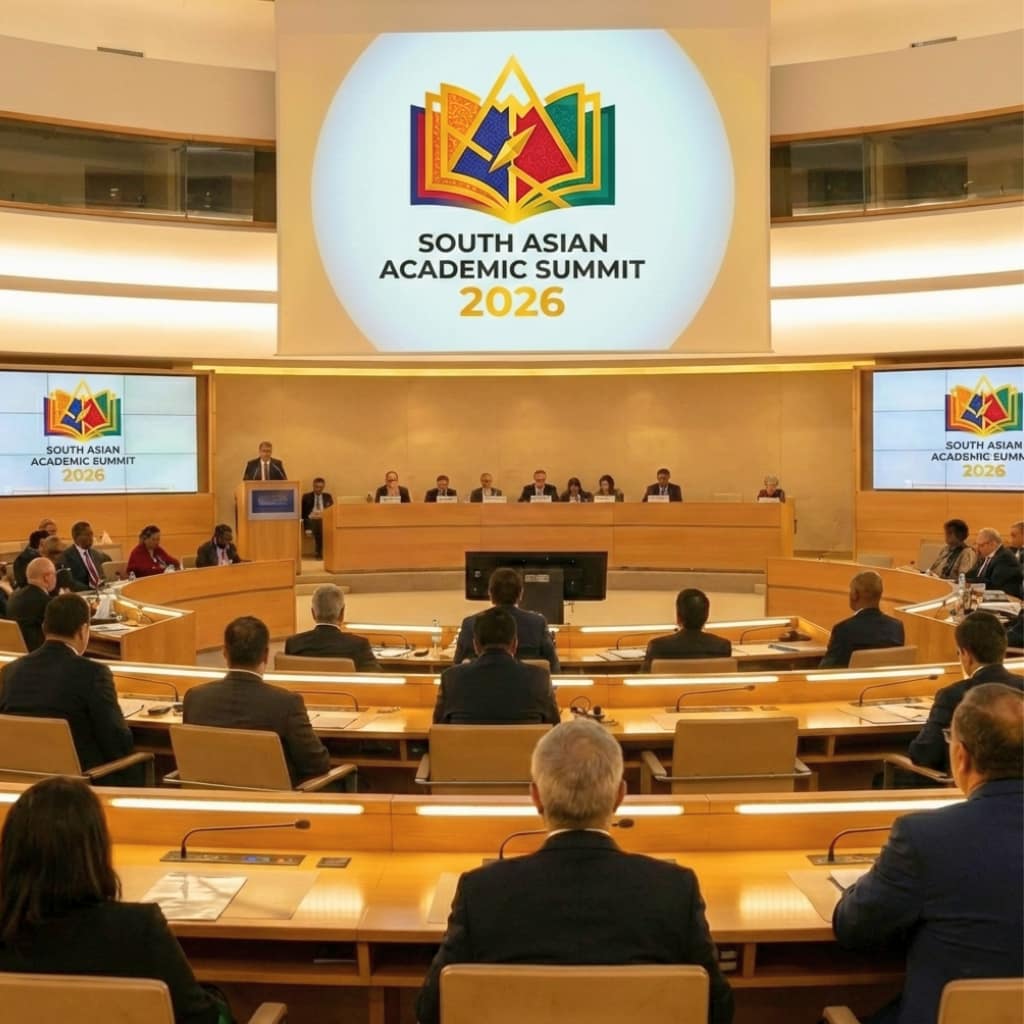
The South Asian Academic Summit, 2026 (SAAS 2026) is a year-long, international Academic Summit envisioned as the South Asia’s largest and most comprehensive Academic event, Organised by the Centre for Development of Intellectual Property and Research (CDIPR), Naovina Development of Intellectual Property and Research Foundation. Conceived as a year-long, multi-disciplinary, transnational academic movement, SAAS 2026 brings together the most comprehensive assembly of scholars, policymakers, professionals, and students ever convened under a single academic umbrella in the South Asian region. Rooted in a strong legacy of organising globally recognised academic forums; including the South Asian Global Intellectual Property Summits, SAAS 2026 represents the natural evolution of CDIPR’s academic vision: moving from issue-specific conferences to a holistic, interdisciplinary and continuous academic ecosystem for South Asia. SAAS 2026 is not conceived as a single conference or an isolated event. Instead, it is envisioned as a twelve-month academic movement designed to strengthen knowledge production, foster cross-border collaboration and translate scholarly research into policy-relevant and socially impactful outcomes. With integrating law, public policy, technology, social sciences, sustainability studies, innovation management and governance, SAAS 2026 seeks to position South Asia as a global knowledge contributor rather than a passive knowledge consumer. SAAS 2026 is expected to host over 2,000 participants from 96 nations, representing a wide spectrum of backgrounds, including academia, public policy, law, governance, technology, innovation, industry, civil society and research institutions. This diverse participation underscores the Summit’s position as South Asia’s largest academic event and a premier platform for cross-border intellectual exchange. Participants are expected from South Asian countries, alongside extensive global representation across Europe, North America, Latin America, Africa, the Middle East, East Asia, Southeast Asia, and Oceania.
The South Asian Academic Summit, 2026 has been designed around clearly defined academic, institutional, and societal objectives:
The central theme of the South Asian Academic Summit, 2026 reflects a decisive shift in the role of academia from passive knowledge production to active societal transformation. SAAS 2026 is built on the conviction that research must move beyond journals and classrooms to influence governance, innovation, sustainability, and human development across South Asia.
Under this theme, the Summit seeks to:
The theme recognises South Asia not merely as a region facing challenges, but as a laboratory of ideas, innovation and indigenous wisdom capable of shaping global academic and policy narratives.
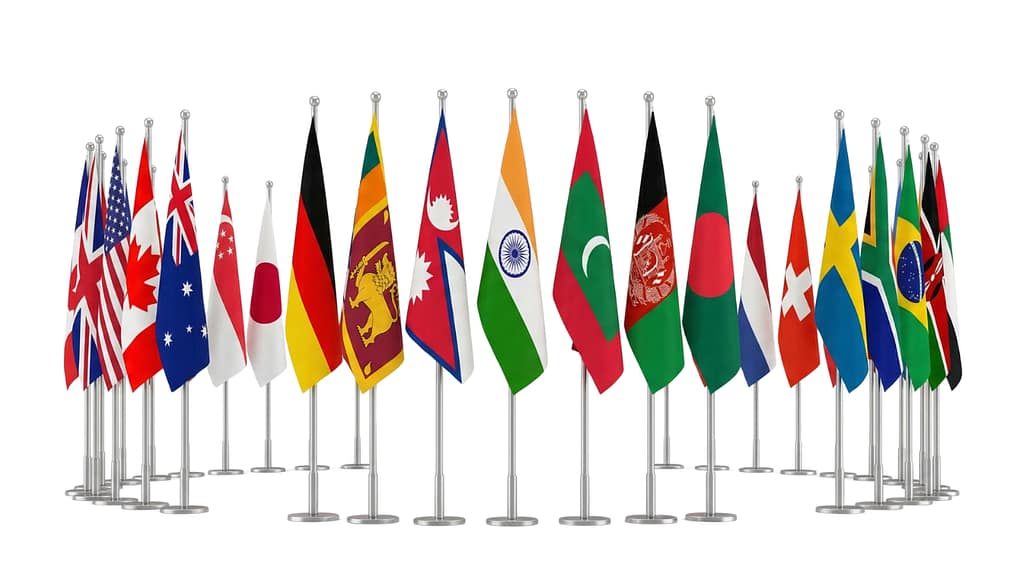
SAAS 2026 is envisioned as a truly transnational South Asian and global academic platform, bringing together scholars, institutions, policymakers and professionals from across the region and beyond.
Core South Asian Countries:India, Sri Lanka, Nepal, Bhutan, Maldives, Afghanistan, Bangladesh | Global Academic & Policy Partners:United Kingdom, United States of America, Canada, Australia, Singapore, Japan, Germany, France, Netherlands, Switzerland, Sweden, South Africa, Brazil, Kenya, United Arab Emirates |



Overview: Examines constitutional governance, judicial independence, democratic backsliding, and comparative constitutional experiences across South Asian states.
Overview: Encourages interdisciplinary scholarship integrating law, humanities, history, sociology, and philosophy to address complex societal challenges.
Overview: Discusses AI governance, platform regulation, digital constitutionalism, and emerging technology laws in South Asia.
Overview: Encourages comparative dialogue between South Asia, Africa, and Latin America on development-oriented legal frameworks.
Overview: Examines regional trade frameworks, digital economy, development finance, and South–South economic cooperation.
Overview: Explores environmental governance, climate policy, ESG frameworks, and sustainable development models in the Global South.
Overview: Focuses on traditional knowledge, geographical indications, cultural heritage protection, and community-based innovation systems.
Overview: Brings together scholars and policymakers to deliberate on regulatory reform, governance capacity, and public policy innovation.
Overview: Discusses fintech regulation, digital payments, blockchain finance, reg-tech, and sup-tech challenges in South Asia.
Overview: Focuses on university autonomy, academic freedom, research funding, rankings, and institutional governance reforms.
Overview: Examines intellectual property, startups, MSMEs, university–industry collaboration, and innovation-driven economic development.
Overview: Concludes the intellectual discourse of SAAS 2026 by outlining priority research areas, academic cooperation goals and policy-oriented scholarship for South Asia.